Esterbrook 940 v1: Difference between revisions
No edit summary |
No edit summary |
||
| (8 intermediate revisions by the same user not shown) | |||
| Line 10: | Line 10: | ||
|'''Descr.''' ||Radio Pen, Version 1 | |'''Descr.''' ||Radio Pen, Version 1 | ||
|- | |- | ||
|'''Tip''' || | |'''Tip''' ||M | ||
|- | |- | ||
|'''Markings''' ||Exterior | |'''Markings''' ||Exterior | ||
| Line 24: | Line 24: | ||
|} | |} | ||
[https://theesterbrookproject.com/SITE%20DOCS/NIBS%20900%20TO%20999.html The Esterbrook Project] describes the Radio Pens: "In 1913, Esterbrook introduced the 900-series of The Radio Pens. Most of the Radio Pens were simply existing popular pens given new numbers and a 'triple silver plating.' The plating was probably nickel plating to prevent corrosion from ink." The #940 is almost certainly based on the [https://peelpenshop.com/products/vintage-dip-pens-nibs-r-esterbrook-co #672 Transmitter Pen]. | |||
''The 1938 Esterbrook Catalog'' says, " | Contemporary advertising in ''The 1938 Esterbrook Catalog'' says, "Extra firm, medium. Smooth action. - Silver finish." An Esterbrook brochure (see [http://www.pendemonium.com/dippens.htm Pendemonium DIP1004]) lists four reasons to use Radio Pens, along with their attributes, such as “Steel as fine as a watch spring" and “The Pens with the Velvet Touch”. The back panel talks of “Steel from purest ore”, and “Special electro-plating to resist the corrosive action of the ink.” | ||
[https://theesterbrookproject.com/NIB%20SHEETS/ESTERBROOK% | [https://theesterbrookproject.com/NIB%20SHEETS/ESTERBROOK%20940%20RADIO%20PEN/ESTERBROOK%20940%20RADIO%20PEN.html The Esterbrook Project] describes this nib as having "a semi-pinched waist with a sharp, turned-up tip. Firm flex. Trapezoidal vent hole." | ||
AAAndrew's [https://thesteelpen.com/category/pen-types/ Steel Pen blog] references a history of Turned Up Point Pens in ''The American Stationer'' (2/12/1889): "The first steel pens made in Birmingham about the year 1837, while providing a ready made instrument for penmen, failed to give that ease in writing which was the characteristic of the old quill. [Steel pens] were uniformly fine pointed and naturally more or less scratchy. The remedy for this was not found until a generation later, when ... the happy idea occurred to turn up the points. ... The penman can write longer with less fatigue than with the ordinary styles. The tediousness of writing is almost entirely avoided, and the relief is so complete that it converts a drudgery into a delight." | AAAndrew's [https://thesteelpen.com/category/pen-types/ Steel Pen blog] references a history of Turned Up Point Pens in ''The American Stationer'' (2/12/1889): "The first steel pens made in Birmingham about the year 1837, while providing a ready made instrument for penmen, failed to give that ease in writing which was the characteristic of the old quill. [Steel pens] were uniformly fine pointed and naturally more or less scratchy. The remedy for this was not found until a generation later, when ... the happy idea occurred to turn up the points. ... The penman can write longer with less fatigue than with the ordinary styles. The tediousness of writing is almost entirely avoided, and the relief is so complete that it converts a drudgery into a delight." | ||
| Line 37: | Line 37: | ||
There are four distinct versions of the Esterbrook #940 Radio Pen in the Chappy's Nibs collection: | There are four distinct versions of the Esterbrook #940 Radio Pen in the Chappy's Nibs collection: | ||
* [[Esterbrook 940 v1 | '''Version 1:''' ]] | * [[Esterbrook 940 v1 | '''Version 1:''' ]] silver-plated finish, company listed as R.ESTERBROOK & CO'S | ||
* [[Esterbrook 940 v1 int | '''Version 1 int imprint:''' ]] | * [[Esterbrook 940 v1 int | '''Version 1 int imprint:''' ]] silver-plated finish, same as Version 1 except with interior imprint | ||
* [[Esterbrook 940 v2| '''Version 2 | * [[Esterbrook 940 v2 | '''Version 2:''' ]] silver-plated finish, company listed as R.ESTERBROOK & Co | ||
* [[Esterbrook 940 v3 | '''Version 3:''' ]] | * [[Esterbrook 940 v3 | '''Version 3:''' ]] silver-plated finish, plus a third line, "MADE IN U.S.A." | ||
(These version names are defined for this collection alone, and are not necessarily industry-wide terms.) | (These version names are defined for this collection alone, and are not necessarily industry-wide terms.) | ||
| Line 54: | Line 54: | ||
==External Links== | ==External Links== | ||
* [https://theesterbrookproject.com/NIB%20SHEETS/ESTERBROOK% | * [https://theesterbrookproject.com/NIB%20SHEETS/ESTERBROOK%20940%20RADIO%20PEN/ESTERBROOK%20940%20RADIO%20PEN.html The Esterbrook Project - 940 page] | ||
* [http://www.whiteapplemultimedia.com/history.html History of Esterbrook - McKinney] | * [http://www.whiteapplemultimedia.com/history.html History of Esterbrook - McKinney] | ||
* [http://en.wikipedia.org/wiki/Esterbrook Wikipedia - Esterbrook page] | * [http://en.wikipedia.org/wiki/Esterbrook Wikipedia - Esterbrook page] | ||
Latest revision as of 18:49, 24 February 2021

| |
| Esterbrook 940 v1 | |
| Manufacturer | Esterbrook |
| Nib No. | 940 |
| Descr. | Radio Pen, Version 1 |
| Tip | M |
| Markings | Exterior |
| Mark 1 lateral L | 940 |
| Mark 2 | R.ESTERBROOK & CO'S |
| Mark 3 | RADIO PEN |
 | |
The Esterbrook Project describes the Radio Pens: "In 1913, Esterbrook introduced the 900-series of The Radio Pens. Most of the Radio Pens were simply existing popular pens given new numbers and a 'triple silver plating.' The plating was probably nickel plating to prevent corrosion from ink." The #940 is almost certainly based on the #672 Transmitter Pen.
Contemporary advertising in The 1938 Esterbrook Catalog says, "Extra firm, medium. Smooth action. - Silver finish." An Esterbrook brochure (see Pendemonium DIP1004) lists four reasons to use Radio Pens, along with their attributes, such as “Steel as fine as a watch spring" and “The Pens with the Velvet Touch”. The back panel talks of “Steel from purest ore”, and “Special electro-plating to resist the corrosive action of the ink.”
The Esterbrook Project describes this nib as having "a semi-pinched waist with a sharp, turned-up tip. Firm flex. Trapezoidal vent hole."
AAAndrew's Steel Pen blog references a history of Turned Up Point Pens in The American Stationer (2/12/1889): "The first steel pens made in Birmingham about the year 1837, while providing a ready made instrument for penmen, failed to give that ease in writing which was the characteristic of the old quill. [Steel pens] were uniformly fine pointed and naturally more or less scratchy. The remedy for this was not found until a generation later, when ... the happy idea occurred to turn up the points. ... The penman can write longer with less fatigue than with the ordinary styles. The tediousness of writing is almost entirely avoided, and the relief is so complete that it converts a drudgery into a delight."
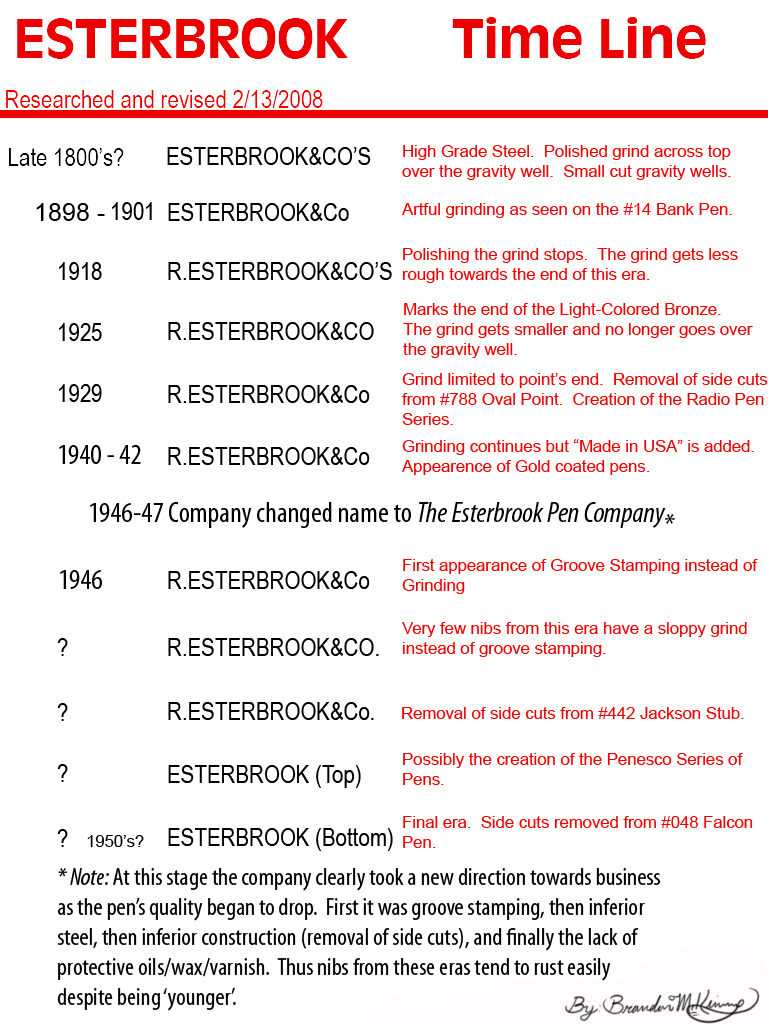
Brandon McKinney's analysis of the markings and grindings date this version of the #940 Radio Pen as about 1918.
Versions
There are four distinct versions of the Esterbrook #940 Radio Pen in the Chappy's Nibs collection:
- Version 1: silver-plated finish, company listed as R.ESTERBROOK & CO'S
- Version 1 int imprint: silver-plated finish, same as Version 1 except with interior imprint
- Version 2: silver-plated finish, company listed as R.ESTERBROOK & Co
- Version 3: silver-plated finish, plus a third line, "MADE IN U.S.A."
(These version names are defined for this collection alone, and are not necessarily industry-wide terms.)
The nib pictured below is Version 1.
Photos
Click any image for a full-resolution photo: 1925 x 560. The image with the ruler is 2300 x 1196.


